
The Krigstein Rhythm
Wherein I actually remember to say what the Krigstein Rhythm is

I don't remember ever making the conscious decision to focus on making conspiracy laced comics, it's just something that evolved because of the organic way that I approach writing. That said, I am a complete sucker for 1970s thrillers like The Parallax View, The China Syndrome, Chinatown, The Long Goodbye, Three Days of the Condor. My favourite film of the past few years is Inherent Vice. There's something very enticing about the conspiracy undercurrent, I particularly like purposely withholding information from the reader to generate greater uncertainty which in turn fosters risk, unease and hopefully a sense of dread. (I think this is because I’m a dick.) It's similar to the whodunnit framing device in some ways, but with the obvious caveat that everyone might be in on it. It's essentially about paranoia and the dissolution of trust. A fear of being caught in a giant web or that the walls are closing in. This type of comic requires the ability to create - to draw - a sense of paranoia, dread, suspense, claustrophobia and, above all, hysteria. If this sounds like your bag, friend, then I recommend buying one of my comics right here.
EC Comics
I just finished a great book written by Grant Geissman, The New Trend: EC Comics. It's a stunning object, which is not remotely surprising given that it's published by Taschen. I have a sizable collection of their books, much to Mrs Wife's chagrin. (She insists that books collect dust, which she's allergic to, and there's no room for more clutter.) It's also a well-researched and very readable book. Thus, I cannot recommend it highly enough. I only got into EC Comics properly after doing Howard Chaykin's Paradigm course, which I’ve mentioned a few times. It's worth repeating again, Chaykin is one of the best teachers I've had and I learned a huge amount from participating in his online tutorials. It's remarkable how much impact EC had with the New Trend in such a small period of time, from 1950 to 1954. There so much to learn from that era with regards to craftsmanship and the language of comics.
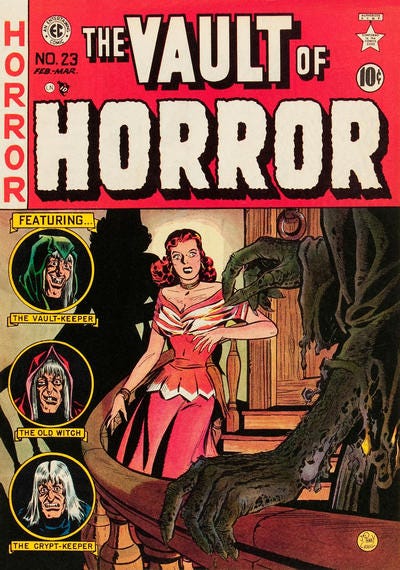
Over the next two newsletters I want to focus on two EC artists, Bernie Krigstein and Al Williamson. I recommend getting The Best of EC Comics Stories Artisan Edition, which reproduces Krigstein's original art from The Flying Machine, In the Bag and The Master Race, as well as Williamson’s A Sound of Thunder, By George!, 50 Girls 50, Food for Thought and Lost in Space.
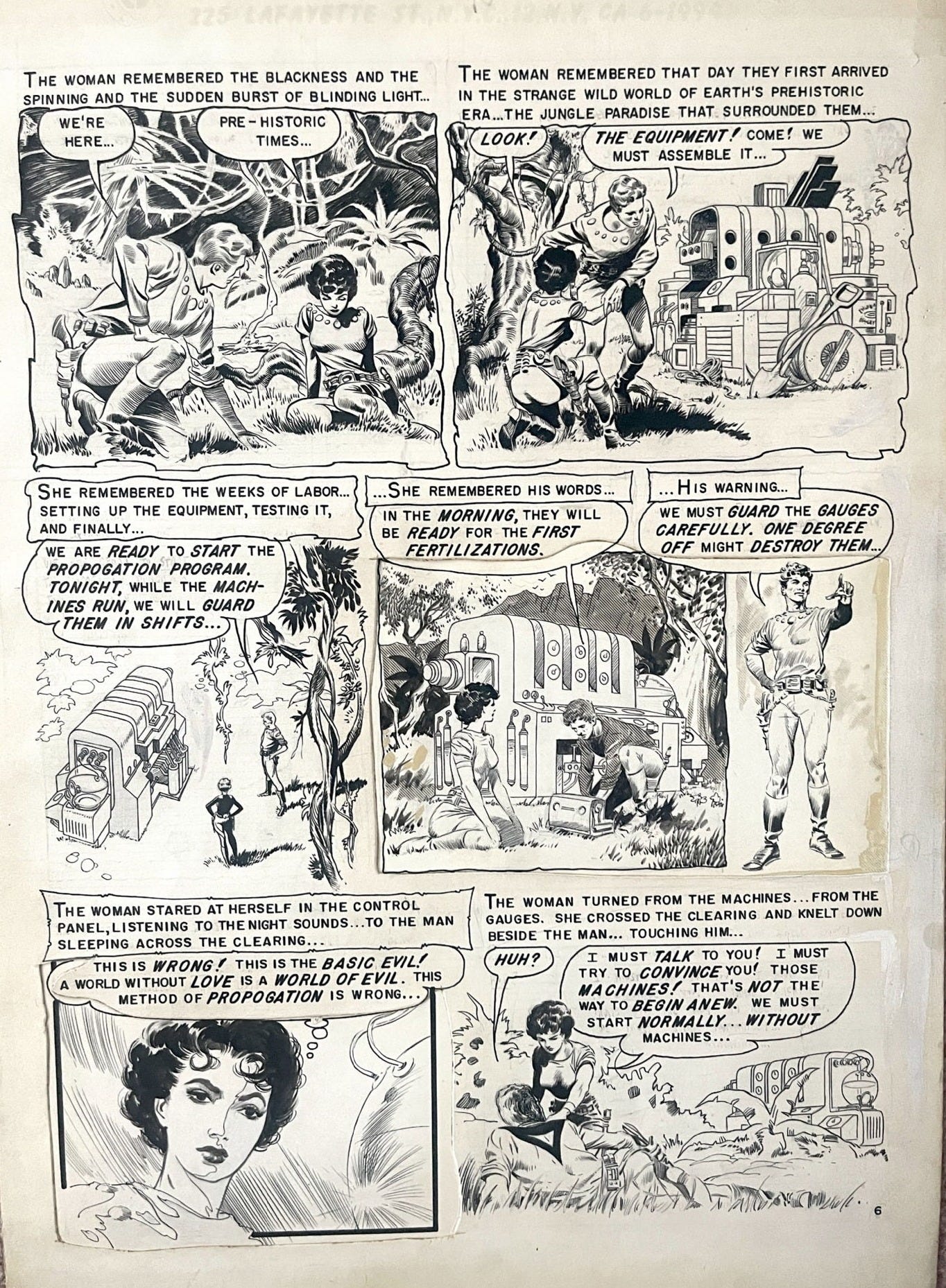
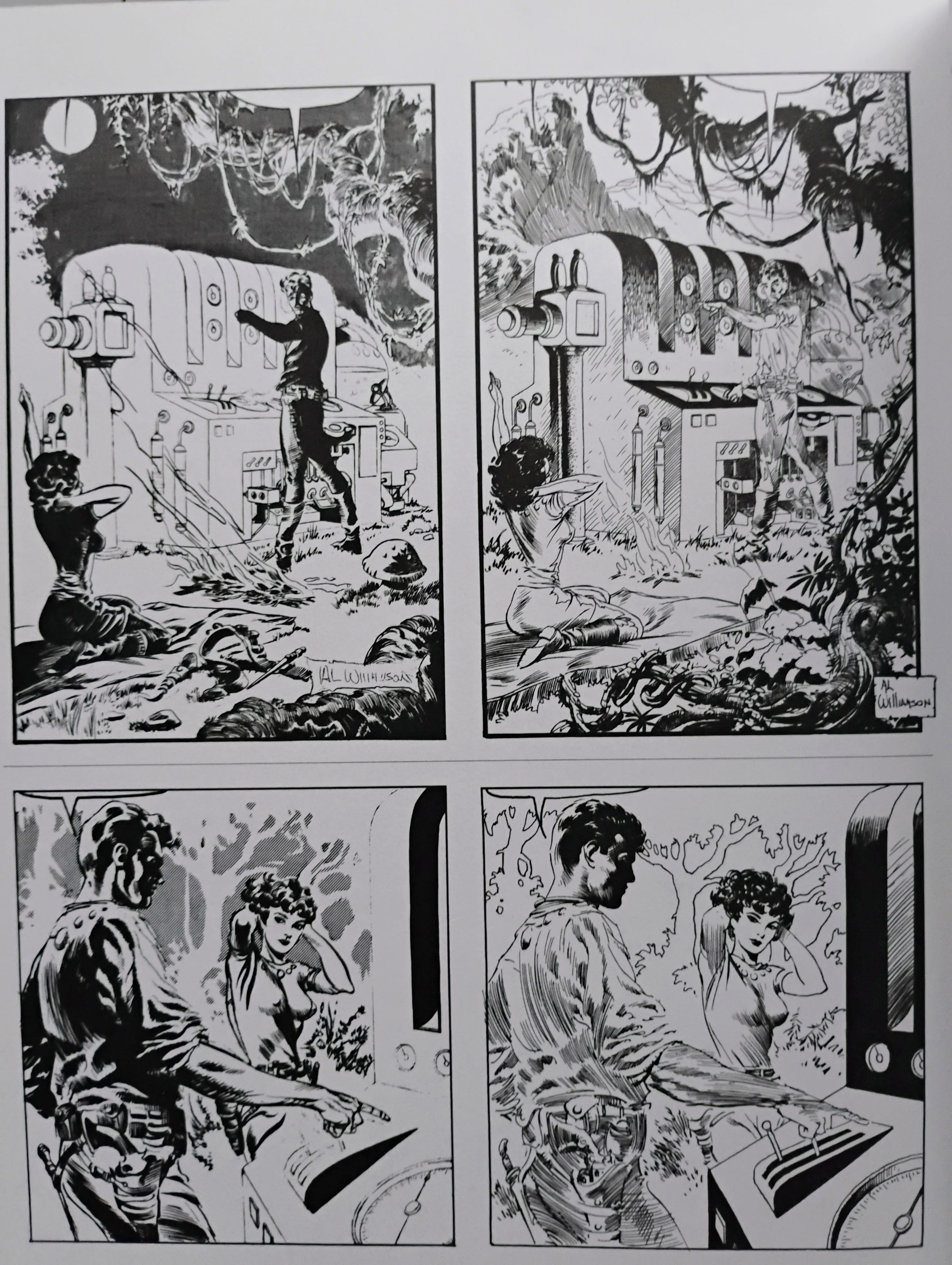
Interestingly, Krigstein's first work for EC Comics was inking Williamson on A New Beginning in Weird Science 22 (1953). What's more interesting is that Williamson hated Krigstein's efforts, took back the art and asked Frank Frazetta and Roy Krenkel to finish the job1. Williamson said2, ‘As usual, I was having deadline problems, so they gave it Bernie to ink - but our styles were completely different’.
I’ve mentioned the Krigstein Rhythm here and there, and I’ve also written about Johnny Craig and Harvey Kurtzman previously.
Krigstein at EC
Krigstein is an interesting comic artist to study and it's fascinating to look at his artistic evolution from National Periodicals to EC Comics, where he would make lasting contributions to to the languages of comics, or perhaps more appropriately, the musicality of comics. Krigstein is unusual in many ways, he was absolutely not a typical comic artist of the time, not least for his preference for comic books than strips (where the money was). In a 1963 interview, he said, ‘I always found comic books more interesting than syndicated material; simply from a formal point of view; because of the possibilities of the form itself: it’s just a matter of space’.
Greg Sadowski’s book, B. Krigstein, is a fascinating source of information on the artist. Sadowski writes, ‘Krigstein seems to have made an effort to fit in at National […] (d)espite Infantino’s inability to guide him, Krigstein had a reasonable grasp of the homogenized National look […] Before advancing into the realm of pure individual expression, however, Krigstein allowed himself a final influence. Alex Toth […] had developed a technique perfectly suited to it's black and white challenges. Toth’s 1952 -1953 work for Standard and his 1952 aviation tale for Kurtzman, “Thunderjet”, are keenly felt in Krigstein’s final Atlas war stories’3.
An artist’s approach and/or style evolves over time, sometimes becoming more or less unrecognisable. Perhaps a good example of this is Picasso's Blue Period, Rose Period, African-influenced Period and Cubism4. It’ worth going back to Toth again, who famously said, ‘I spent the first half of my career learning what to put into my work, and the second half learning what to leave out’. That doesn't just apply to the composition of the page, as some influences can be discarded over the course of a career. When the latter happens it often looks as though an artist has reinvented their approach or style, when in reality it can just be the result of a natural evolution when their own style comes to the fore. Going back to Krigstein’s period at National, an artistic evolution can occur as a point of resistance or opposition. It's an obvious point and certainly one I can relate to, given the rather large chip of my shoulder that I carry about. I work hard to get better at drawing because I Am motivated to prove art teachers from my school days wrong.
Krigstein’s influences originated from well beyond comics. Cited in Sadowski's book (p.161), he said, ‘…the golden age of illustration, that was something I really didn't experience as an important influence. Names like Schoonover, N.C. Wyeth and so on. They never really moved me. My influences were all painters and sculptors. From the point of view of emotional content, I think I was influenced by writers, Russian writers… Chekhov short stories, for instance. That's why I was interested in conveying narrations in stories’. Krigstein also added, ‘the guys that inspire me ... Bierstadt, and a couple of other early Americans; Remington, of course, is great, but the really greatest of them all is Winslow Homer, and these are the artists that inspire me very much’.
Master Race is commonly put forward as Krigstein's masterpiece, and it is for sure one of the greatest comics ever produced. However, I'm also fascinated by Monotony from Crime Suspenstories 22 (1954), which was written by Alan Feldstein. Krigstein said of his approach5, ‘… I deliberately kept the exact same setting, without changing the angle, without changing the distance, the result of which was to multiply and and intensify the slightest change of attitude and expression of the character, to focus attention on the crucial aspects of storytelling and real movement - the movement of character'.
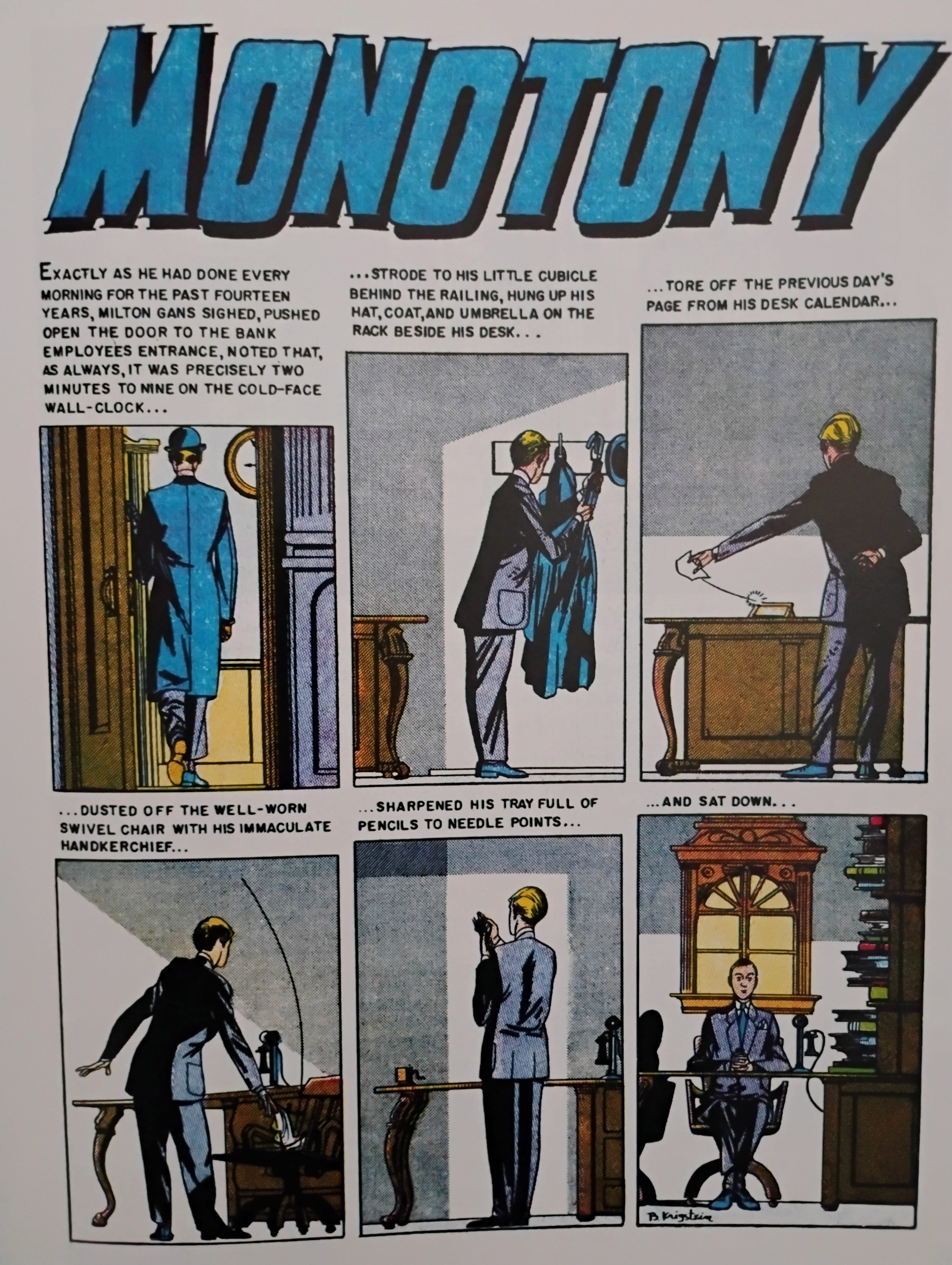
This fascinates me, because it describes a musicality in comics. A steady note that usually is punctuated by a dramatic note, but instead Krigstein maintains it. (I’ve noticed that Seth did this in Clyde Fans (2000).) I think the steadiness of the note settles the reader and can ultimately build dread if the cartoonist has the temerity to stretch it out enough. My instinct would be to punctuate it, no - puncture it, with a close-up of the staring eyes of a face decorated with beads of sweat a la Johnny Craig (or Ditko).
Krigstein suggested this came from a cinematic influence, ‘I feel this is sort of like Hitchcock. In Psycho, for example, before the violent scenes everything is very still and quiet with slow moving camerawork and little sound, and then everything hits your senses with full force — Herrmann’s shrieking music, quick cutting, etc. In other words, like you, he’s using his medium for psychological effect’. I’ve written before about Hitchcock’s influence on comics (and vice versa) and I recommend again Truffaut’s book, Hitchcock: A Definitive Study of Alfred Hitchcock. I got into comics relationship with film with regards to noir here too.
However, The Catacombs, written by Carl Wessler and published in Vault of Horror 38 (1954), is where the Krigstein Rhythm really crystalised. The Krigstein Rhythm requires the subdivision of panels, in Krigstein's words, ‘to get more more movement and richer dramatic feeling. In other words, I multiplied the amount of action from one to two’6. Doubling the action essentially slows time down on the page, which I spoke with Gregg Schigiel about before.
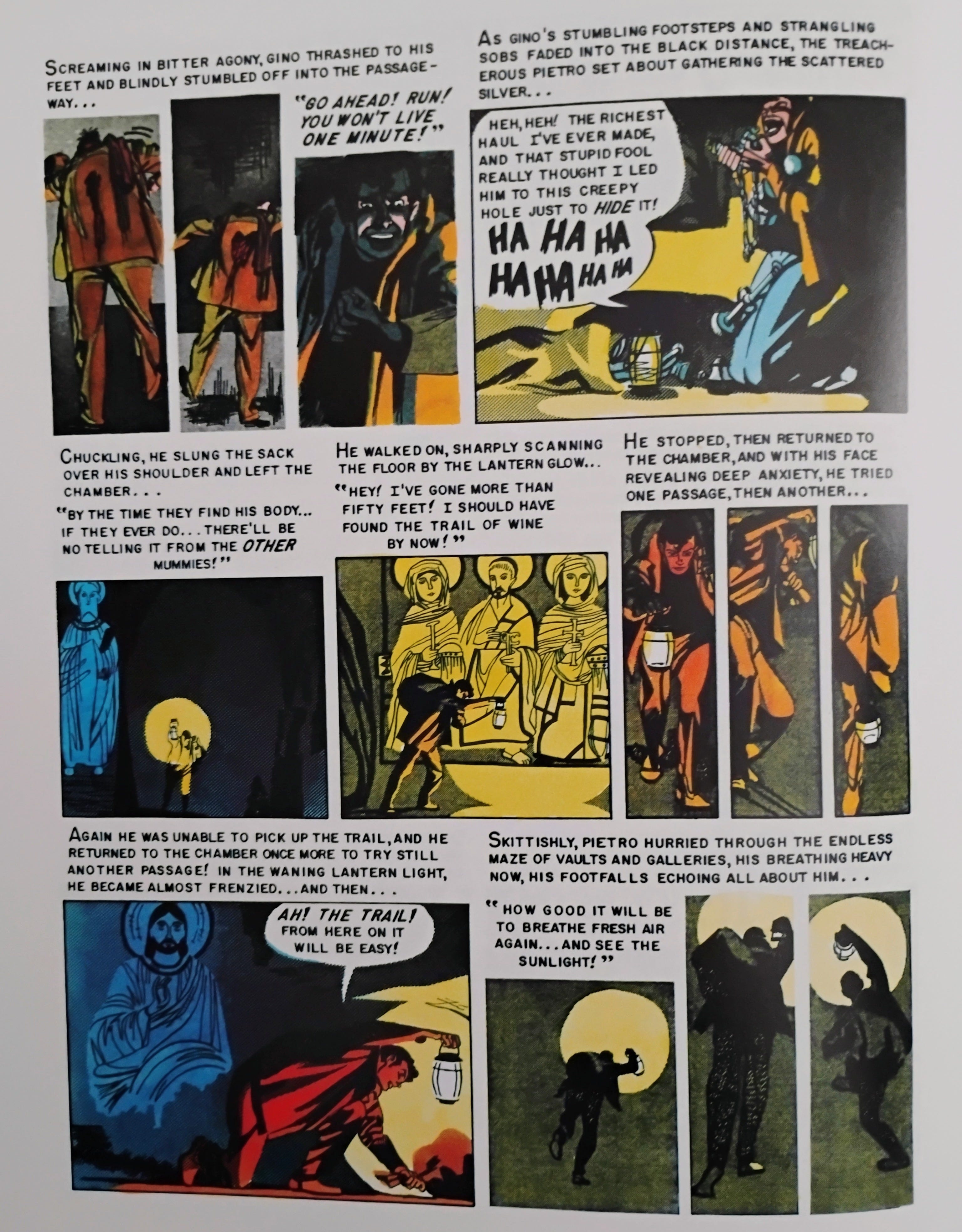
Sadowski notes that on Key Chain (Crime Suspenstories 25, 1954), Feldstein’s layouts specified 18 panels on the final two pages, which Krigstein instead delivered over 34 panels. Krigstein said, ‘I began to see twelve panels, eighteen panels, in the same amount of text. I began to see people doing all sorts of things, and it just became ridiculous to have them doing all this stuff in six panels… because it's what happens between the panels that's so fascinating. Look at all that dramatic action one never gets a chance to see’7.
The Krigstein Rhythm is maybe a bit like shooting a roll of film on a high shutter speed and unlike Kirby it doesn't just show the instant before or after an action, it shows before, during and after an action. For this reason, I like applying it on action scenes, which makes it feel like the frenetic Greengrassian editing of the Bourne films.
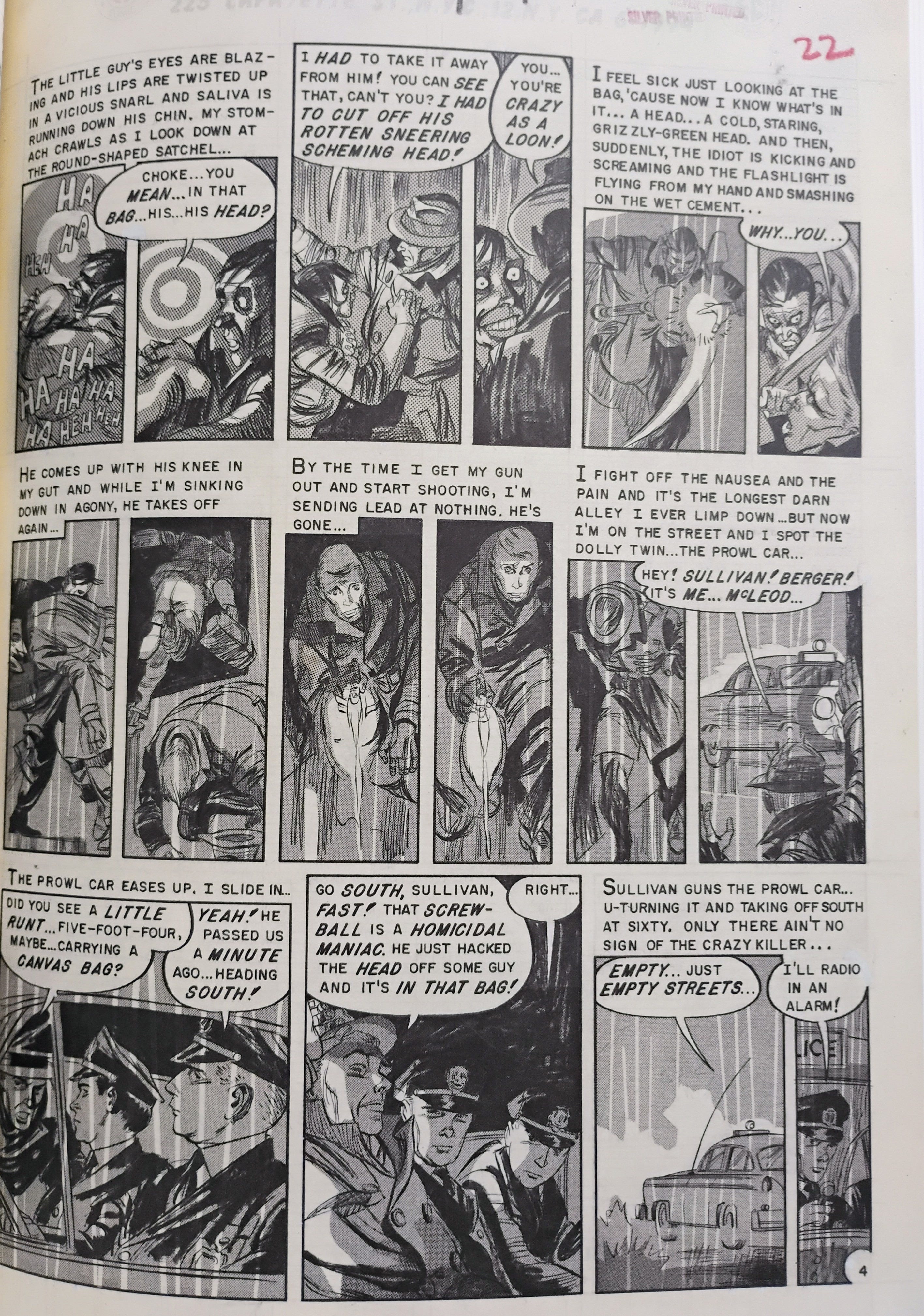
O’Neill writes, ‘When Berni Krigstein subdivided a page into slivers of time, he had the sense to establish, in a normal image, the location and characters, before using his exquisite sense of timing and design to zoom in on a particularly important detail or moment of the action’. This underlines the importance of the establishing shot, which Kristein did still use to pronounce the setting, but it overlooks that he deviated from the standard EC half-splash on his most radical work.
Krigstein is someone I would describe specifically as an artist with a high capacity for storytelling, rather than a cartoonist, illustrator or comic artist. Maybe my view is prejudiced by knowledge of his later career and the simply recognition that he didn’t write scripts. Shapira argues, ‘If the script is mediocre (“Slave Ship”) Krigstein makes it good. If the script is good (“The Catacombs”) he makes it great. Krigstein’s stories work because he visibly struggles against the constraints of the EC style. His ‘subdivision’ of the pre-lettered page—splitting the room for what would be presumed to be one panel into several distinct images—has long been the stuff of legend, finding a way to make even most word-heavy tale into something visually exciting’.
Shapira notes further, ‘Kurtzman succeeded because he worked within a method he devised. Krigstein succeeded because he worked against that method. The stories he draws are soaked in themes of paranoia and imprisonment - almost as if nodding to an artist straining to free himself from a creative straitjacket. One can only imagine a world in which this Orson Welles of comics got to make work as he wanted to’.
The ‘paranoia’ and ‘imprisonment’ Krigstein evoked is either a by-product of those subdivided panels which, due to the limited space of the comic page tier, become increasingly narrow. This generates a claustrophobic air in the panels, particularly when showing full figure shots. The paranoia is generated from extreme close-ups within those narrow panels. Add in the Craig/Ditko beads of sweat and it’s paranoia bordering on hysteria.
For further insight into Krigstein, I recommend reading his 1963 interview with Bhob Stewart and John Benson, which can be found in its entirety here. The Sadowski book is obviously essential, not least because I’ve cut and pasted a fair chunk of here, rather shamelessly. Hi biography on Lambiek can be found here and his bibliography here.
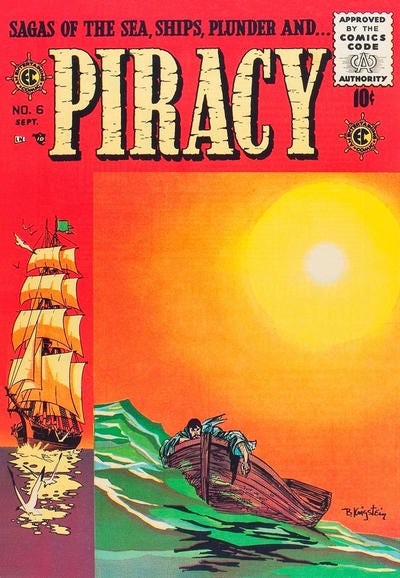
When I first saw Krigstein’s work, my initial reaction was one of dislike, for his ‘ugly’ style. However, upon studying it for that magical, musical rhythm, I have found myself falling hopelessly in love with his style. His work has profoundly influenced my understanding of the comics craft and my application of it.
To fully understand Krigstein is to look beyond the intensity of the page design and see the rhythm of the storytelling. As he told Stewart and Benson, ‘l think that a very good artist can experiment with layout, but what I’m discussing is extended dramatic development, and this is what really always interested me in comics — the fact that one could develop a dramatic idea, more or less like a play’. His influence can be found very strongly in the work of Jim Steranko and Frank Miller8. What’s really remarkable is that he only ever drew 44 stories for EC Comics.
Next Time!
It’s time for Al Williamson.
From Sadowski, G. (2002) B. Krigstein, Fantagraphics.
Ibid.
Ibid., pp138 - 140.
Pablo Picasso - Artists - Mnuchin Gallery https://share.google/L4unG77w7t8aAlZoM
From Sadowski (2002), p. 166.
From Sadowski again, p.175.
Ibid., p.177.
Enlightening stuff, thank you! While reading those selected pages I’m reminded why I can’t fully enjoy EC comics. The verbosity takes me out of the ‘comic’. They show AND tell, hampering my enjoyment. Very interesting to consider that Kurtzman defined a method and Krigstein fought against it… The idea that it’s all about what happens BETWEEN the panels feels counter-intuitive, perhaps that’s what makes comics interesting? By increasing the panels, he’s reducing what is going unseen, hand-holding the reader. Certainly feels musical, as you suggest.
Great piece! Good companion to your Mega City Book club discussion. Lovely examples, have a few EC collections and often revisit. But just buy one of your comics?! Intending to get all eventually, great list of conspiracy films too!